

Run a small campaign
--dry-run to preview the same plan without execution.
This production campaign runs four paired cases.
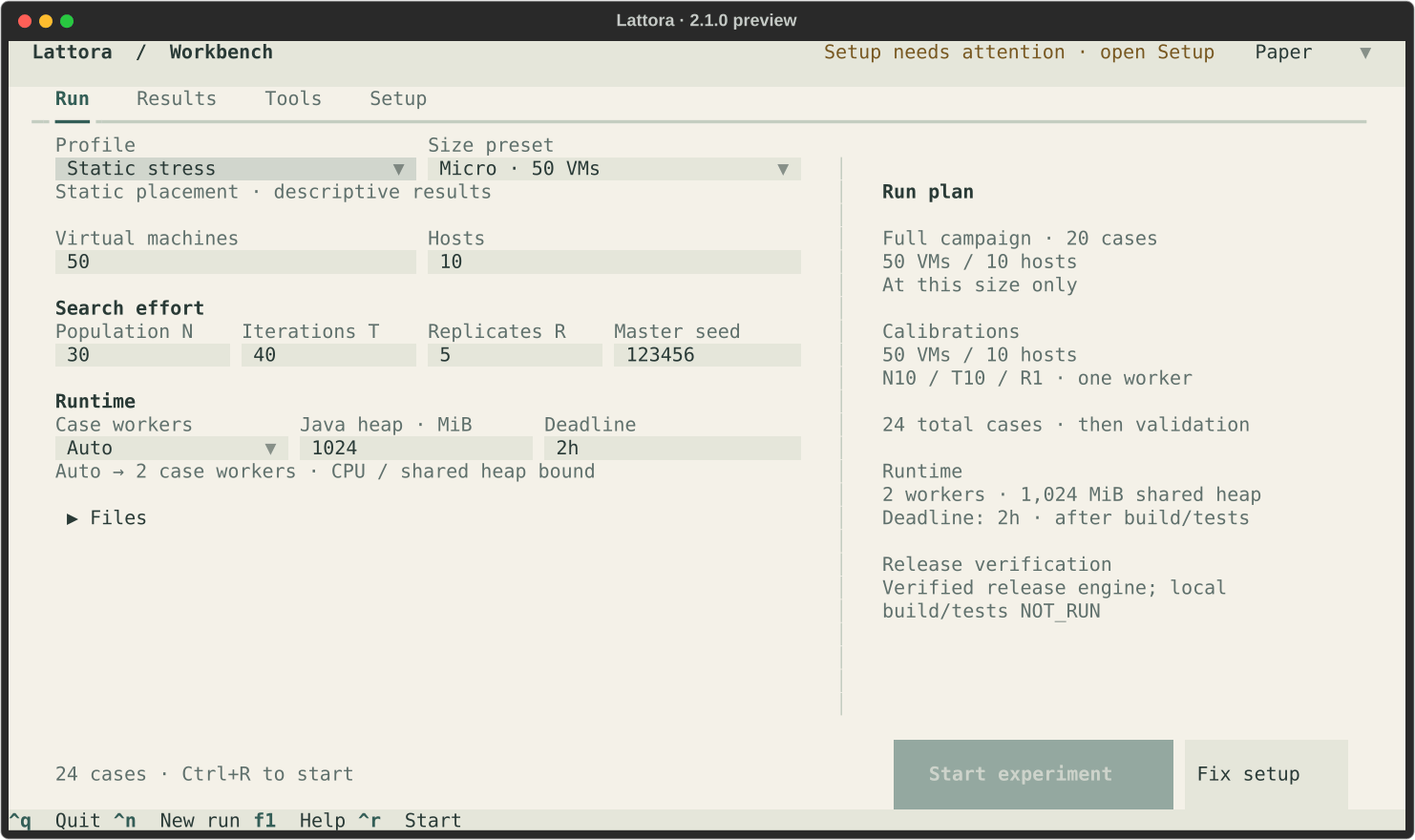
Stress controls in Paper, captured from the 2.1.0 preview. This 50-VM configuration was not executed.
Separate calibration from production
Short pilots use N10/T10/R1 at up to 100 VMs, 500 VMs and the selected size. They preserve the VM/host ratio and omit duplicate sizes. Pilots run serially. Their measurements stay out of production summaries. The deadline covers calibration, production and validation. Source build/tests are outside that deadline.Choose a size
The default is
small, N30/T40/R5 and a 2h deadline.
A preset is an input choice, not a completion guarantee.
Release acceptance checks bounded Stress, not every preset at full effort.
Full larger campaigns and sustained limits remain planned in #21.
Workers and memory
--workers auto uses available CPUs and the shared heap.
It allows at most one worker per 512 MiB, capped at 32.
Explicit counts remain bounded by those limits. Use --workers 1 for serial runs.
Each simulator event loop stays sequential. Seeds, pairing and publication order remain fixed.
Research keeps one pending case per worker. Stress can queue four per worker
(128 maximum) and spool scalar evidence to disk.
More workers do not make a large case fit.
Linux checks /proc and visible cgroup-v2 ancestor limits.
macOS counts free, inactive and speculative pages with the actual page size.
It excludes compressed memory and swap.
Preflight does not reserve RAM; sampled RSS can miss brief peaks.
For a scaling report, keep machine/runtime, size, N/T/R, seeds, workers, heap,
deadline, elapsed time, sampled RSS, output volume and validation cost.
CLI options · Model assumptions.